
It’s in the Bag
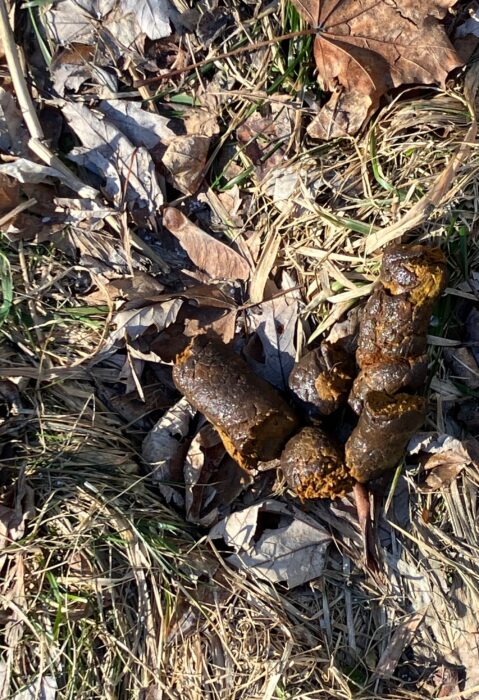
Now you’ve stepped in it.
Dog shit smears the bottom of your sneaker and oozes into the nooks and crannies of the sole. When I was a kid, this happened a lot. In the 1960s, no one bothered to pick up their dog’s poop. We certainly didn’t—that would be gross! And, since leash laws didn’t exist then, dogs wandered and pooped everywhere. I got pretty good at getting the shit off my shoe. Wipe it on a patch of grass or dirt, dabble the bottom in a puddle, use a stick. Repeat.
When you think about your own dog, leaving some poop on the ground or street doesn’t seem like such a big deal. But there are millions of dogs in the United States. There’s no way to know for sure, but it’s probably reasonable to say 80 million (see my article “A Few Words About Numbers”). The EPA estimates that a typical dog generates 274 pounds of poop per year. That adds up to 10.96 million tons of poop per year. Where does it all go?
Into the water and soil. Dog waste contributes significantly to water pollution, especially in crowded urban and suburban areas. As dog feces dissolve in water, they consume oxygen that fish and other aquatic wildlife need. Dog waste may carry bacteria, viruses, and parasites that can spread to other animals, domestic and wild, and to people. In 2020, the journal with the shudder-inducing name Parasites and Vectors published a study of dog parks in 30 metropolitan areas across the U.S. Researchers tested 3000 dogs and found that one in five of them carried parasites, most commonly hookworm, whipworm, and giardia. Dog waste is a vector for spreading these parasites. When feces sit on the ground, the parasites’ larvae can enter the water and soil. Testing found that parasites were present at 85% of the dog parks studied, and these parasites are nasty.
Picking up after your dog is gross, but it matters. I don’t know how or when, but Americans have started to pick up the poop. The Maryland Department of the Environment complains that 40% of Americans still don’t pick up after their dogs, but that means that 60% do. I find that number encouraging. No one wore seatbelts when I was a kid either, but now about 92% of us do.
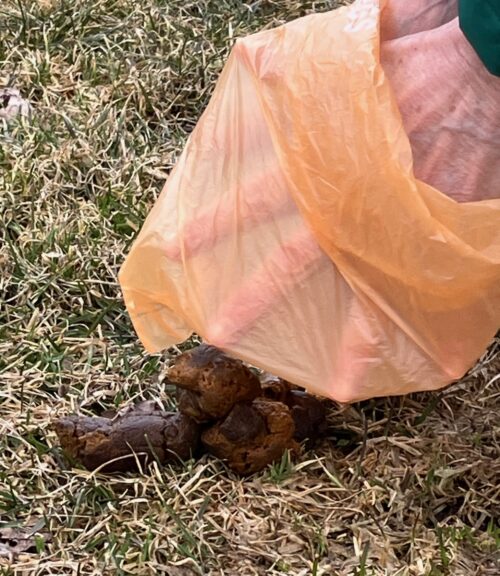
This change in behavior created a brand new market—for poop bags. Entrepreneurs jumped in. Today, with people picking up after roughly 48 million dogs twice a day, that’s an impressive market. Poop bags come in all sorts of bright colors—green, yellow, pink, orange, blue, and purple. They’re emblazoned with paw prints, cartoon dogs, clever logos, and even piles of chocolate-colored poop with smiling faces. (Yikes–whose bright idea was that graphic?) Some bags are scented. Some have handles so you can tie them off easily. They may come with small plastic dispensers–shaped like fire hydrants or dog bones, of course––that can be attached to your dog’s leash so you’ll always have poop bags with you.
For years, I refused to buy a bag for poop. I saved produce, newspaper, and bread bags and used them, but as I started keeping most of those old plastic bags to reuse at home and for grocery shopping, I didn’t have enough left over for dog poop. I started buying rolls of bags and then realized I was contributing to another significant problem: plastic waste and the presence of microplastics in the environment.
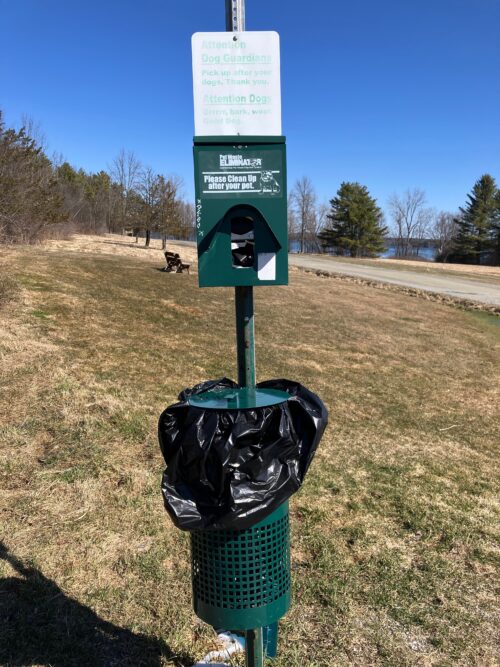
Again, entrepreneurs––many well-meaning, others pretending they are––have jumped in with alternatives: recycled plastic bags, bags made from plants, biodegradable bags, and compostable bags. These bags are often packaged in brown or green cardboard to signal that they’re “green.” Bag dispensers may be made of canvas or silicone. It all sounds good.
I switched bags. First, I tried recycled ones. They’re marginally better than new plastic, but they’re still plastic and use additional energy to manufacture. So maybe not the best choice. Next, I tried a biodegradable brand, but the bags kept splitting. (Now, that’s really gross.) I tried another brand and kept my hands clean. Finally, I found some compostable bags, which didn’t split, but I can no longer get them (more on this below). Instead, I’ve been able to get a corn starch-based bag at my local pet store. But is this the best solution?
Not that long ago, I realized that I really didn’t have a clue what all the labels mean. What is plant-based plastic really? Is plant-based plastic better than petroleum-based plastic? Biodegradable plastic sounds great, but are these bags really biodegradable? Are some bags really compostable?
The answers are complicated. In May, 2024, The New York Times ran an article entitled “Is Biodegradable Plastic Really a Thing?” The answer: no, not yet.
When I first drafted this article, I gave up in confusion and discouragement at this point. The draft sat on my desktop for months. After another go at it, here’s what I can sort out.
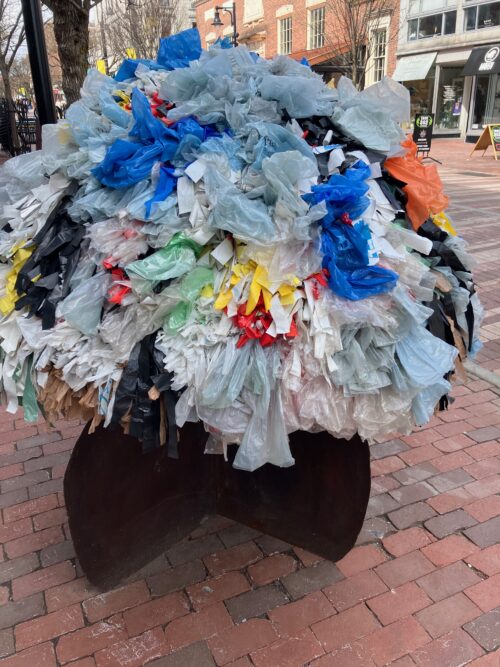
Rebecca McGee Tuck, Symbiosis, 2022-26. Collected single-use plastic and steel. 67 x 60 in.
Plastic is plastic, regardless of its source. Plastic is a very large, long-chain molecule, called a polymer, composed of repeating patterns of smaller molecules, called monomers. Polymers may be natural (starch, amber, wool, rubber) or synthetic (polyethylene, synthetic rubber, silicone). The monomers that make up plastic may come from plant-based or petroleum-based sources, and some plastics come from both.
Plastic is durable and versatile. It can be used for an astonishing array of things, from cling wrap to PVC pipes to peanut butter jars to fast-food containers to medical instruments to dental floss to laptops. Single-use plastic––such as drinking straws, cups, and dog poop bags––has been the target of the most concern, reform, controversy, and innovation. What makes plastic so great is precisely what makes it terrible: its durability. I still have a plastic bag from the bookstore where I worked in 1982. I don’t lug it around, but it’s in amazingly good shape. Some plastics take hundreds of years to break down. Plastics begin to shed and break apart, leaving behind micro-plastics that are working their way into living systems, including the bodies of humans and animals alike, and damaging our health.
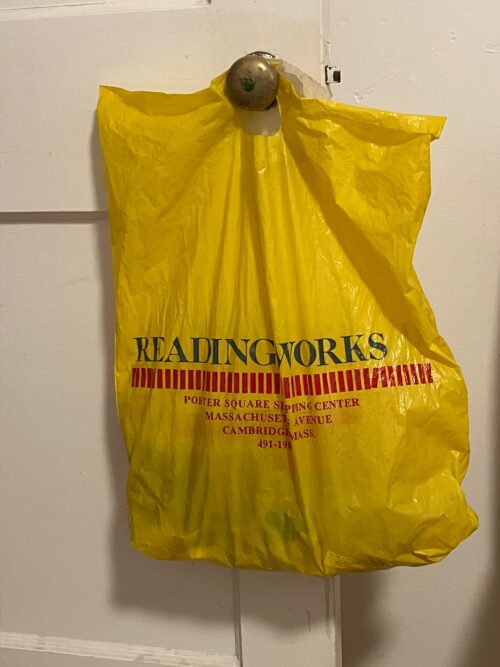
The store closed years ago but the bag’s still here.
Biodegradable plastics are designed to break down into smaller pieces more quickly so that they can be ingested by microbes, while compostable plastics are designed to break down even more readily in a still shorter span of time leaving behind water, CO2, and mulch. The goal is to speed up the breakdown processes and reduce plastic waste while leaving the least amount of microplastic behind.
Here’s a run-down on some terms that I couldn’t define before.
Recycled plastic: This often means that some of the plastic is recycled. You have to read the fine print. One bag I saw online was touted as “green” but had little more than a third recycled plastic.
Plant-based plastic or bioplastic: There are neither standard definitions nor industry standards for these terms. These plastics are generally made from plant-derived molecules (often starches) rather than petroleum, but they may be a blend of both. They may or may not be biodegradable. Plant-based or bioplastics are better for at least one reason: they don’t use up more petroleum.
Biodegradable plastic: These plastics may be made from plants, petroleum, or a blend of both. They are designed to break down into harmless components under the right conditions—with water, oxygen, and high temperatures. There are some certification processes to ensure that biodegradable means what it says it means, but not always. These plastics, as opposed to compostable plastics, are more likely to leave microplastics behind. Certified biodegradable plastics are designed to break down fully within a year.
Compostable plastic: Despite what I was inclined to think given the word compostable, compostable plastic, like biodegradable plastic, may be made from either plants, petroleum, or both. It is not necessarily “green” in the way we might think. It breaks down only under the right conditions—with water, oxygen, and high temperatures. There are certification processes, in both Europe and the United States. Certified compostable plastics are designed to break down fully into mulch within 12 weeks under the right conditions.
But there are two major caveats.
First, both biodegradable and compostable plastics require particular conditions—only available in industrial composting facilities—to break down. As you may know, even some supposedly compostable plastic packaging does not break down as advertised, and composting facilities often refuse to accept it. In the U.S., industrial composting facilities don’t accept bagged dog poop.
In 2012, the Federal Trade Commission warned 15 companies that sold “oxodegradable” waste bags that their marketing might be deceptive, since their bags would end up in landfills without enough oxygen to biodegrade fully within a year or compost within 12 weeks. They were given two years to prove their claims or to change their marketing. Based on the 2012 Guides for the Use of Environmental Marketing Claims, or the green guides, this official alert obviously applies to poop bags since they’re banned from industrial composting facilities in the U.S., and probably explains why the compostable bags I used for a while are no longer available.
Second, using plants, often cornstarch, to create plastic doesn’t magically fix the problem. Starch-based plastic sheds the way petroleum-based plastic does, leaving behind starch-based microplastics (SMPs) that enter the environment. These SMPs may be destructive, too. In 2025, the Journal of Food and Agricultural Chemistry published the results of a study—sadly but not that surprisingly, the first of its kind—to assess the health effects of exposure to SMPs by feeding mice food that contained “environmentally realistic doses” of SMPs. They found “widespread” effects on blood glucose metabolism and signs of organ damage, among other things. In our panic to solve one problem, we have rushed toward a solution that may create another problem.
Fortunately, people around the world are working on ways to create genuinely biodegradable plastic. One team is trying to use cheese waste byproducts to make a plastic that will more easily biodegrade, while simultaneously cutting back on food waste and related emissions. Another team is using corn cobs. These projects are hopeful, but we’re not there yet.
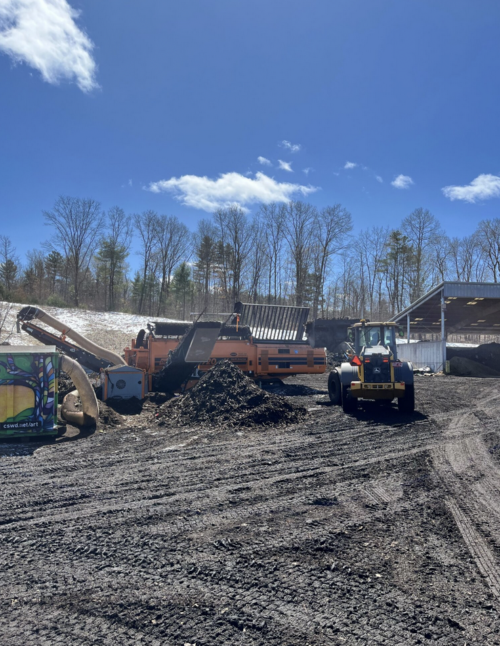
Our local composting facility
So what’s a dog owner to do? In January, 2025, another New York Times article posed the practical question, “What Kind of Poop Bags Should I Use?” There’s no good answer besides “Do the least harm.” These suggestions draw on those in the article.
The best option is not to use any bag at all. Scoop and flush, but only if your town or city’s sewage system can handle it. Our city is upgrading the sewage system so that we can build more housing, so I doubt the system can handle added dog waste in the next few years. Never flush any kind of poop bag down your toilet, and never scoop and flush if you have a septic system.
Second best: Reuse plastic bags that will end up in the landfill anyway. You’re using “recycled” plastic without adding any extra manufacturing or environmental costs. I’m trying to reuse bags a few times first—and then add them to my stash of poop bags.
Third best: Make the best of a bad deal. Use compostable plant-based plastic bags. Make sure the bags have been evaluated for biodegradability, disintegration, and compost quality by an organization such as the Biodegradable Products Institute (BPI) and meet the U.S. standard ASTM D6400. This means that the bag will compost in an industrial composting facility.
Also look for TUV Austria certifications for both industrial (OK Compost) and home composting (OK Compost Home). Your best choice is to use a bag that will compost in a backyard compost.
These certifications mean that the bag has been tested in real-world conditions, is compostable, and will become usable mulch in the right setting. But remember that commercial and municipal facilities don’t accept dog poop, nor can it be composted in your backyard and used for vegetables–though you can use it for the lawn or flowers.
But, as noted earlier, compostable dog poop bags aren’t marketed here. The bags we use in our food compost bucket are sold here because they end up in industrial composting facilities, but they’re much too big. Recently, I found a New Zealand pet-products company online that sells in the U.S. For now, I’m trying these bags, and so far so good. The bag and the poop will end up in a landfill, but at least once it’s there, the plant-based home-compostable bag has a better chance of breaking down, and leaving fewer microplastics behind.
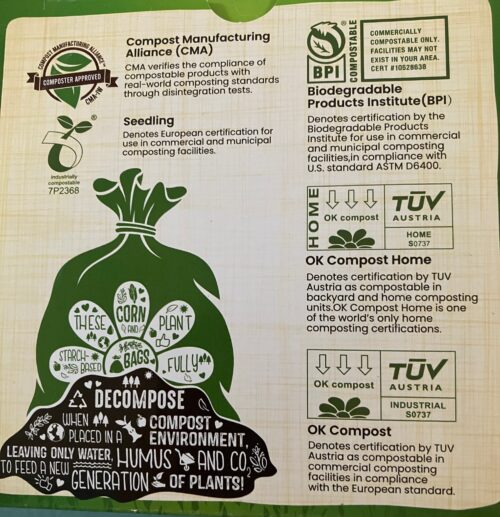
This label appears on a box of the bags we use in our compost bucket. Vermont now has a composting requirement.
The solutions for dog owners aren’t great. But we can still be good neighbors, by picking up the poop, cutting down on water pollution, and limiting the spread of parasites, viruses, and harmful bacteria to dogs, wildlife, and other humans.
And we’ll leave less dog shit on the ground for other people to step in.
References (in the order of their first appearance):
“Scoop the Poop.” Maryland Department of the Environment. maryland.gov.
Julia Wuerz. “Leaving Pet Poop on the Sidewalk Isn’t Only Bad Manners—It’s Hazardous.” Scientific American (February 20, 2024).
Kristina Stafford, et al. “Detection of Gastrointestinal Parasitism at Recreational Canine Sites in the USA: The DOGPARCS Study.” Parasites and Vectors 13 (June, 2020).
Hiroko Tabuchi, “Is Biodegradable Plastic Really a Thing?” The New York Times (May 24, 2024).
Rebecca McGee Tuck, Symbiosis, 2022-26 (collected single-use plastic and steel, 67 x 60 in). Contemporary Art and Our Environment, March, 20- June 20, 2026. Burlington City Arts Center.
“Demystifying ‘Compostable’ and ‘Biodegradable’ Plastics.” Fact sheet (July, 2024). Beyond Plastics. beyondplastics.org.
“FTC Staff Warns Plastic Bag Marketers That Their ‘Oxodegradable’ Claims May Be Deceptive.” Federal Trade Commission News and Events. News Release: October 21, 2014.
Jing Liu, et al. “Long-Term Exposure to Environmentally Realistic Doses of Starch-Based Microplastics Suggests Widespread Health Effects.” Journal of Agricultural and Food Chemistry73:16 (April 9, 2025).
Rachel Nuwer, “What Kind of Poop Bags Should I Use?” The New York Times (January 27, 2025).